A study published in Napoleonica. The Review looks back over two centuries of research into the Boulogne camp and highlights the contribution of the work by Régis Jonckheere and André Lesage.
A study of two centuries of research
The latest issue of Napoleonica. The Review is devoting an in-depth study to the Boulogne camp, written by Frédéric Lemaire, an archaeologist at Inrap and associate researcher at the University of Lille - CNRS.
Title Writing and rereading the Boulogne camp: history, memory and archaeology, This article looks back over more than two centuries of accounts, research and promotion of this major site in Napoleonic history.
The author shows how the Boulogne camp has gradually been studied, interpreted and passed on, from the first accounts in the 19th century to the most recent scientific and archaeological work.
The Boulogne camp, a major site in Napoleonic history
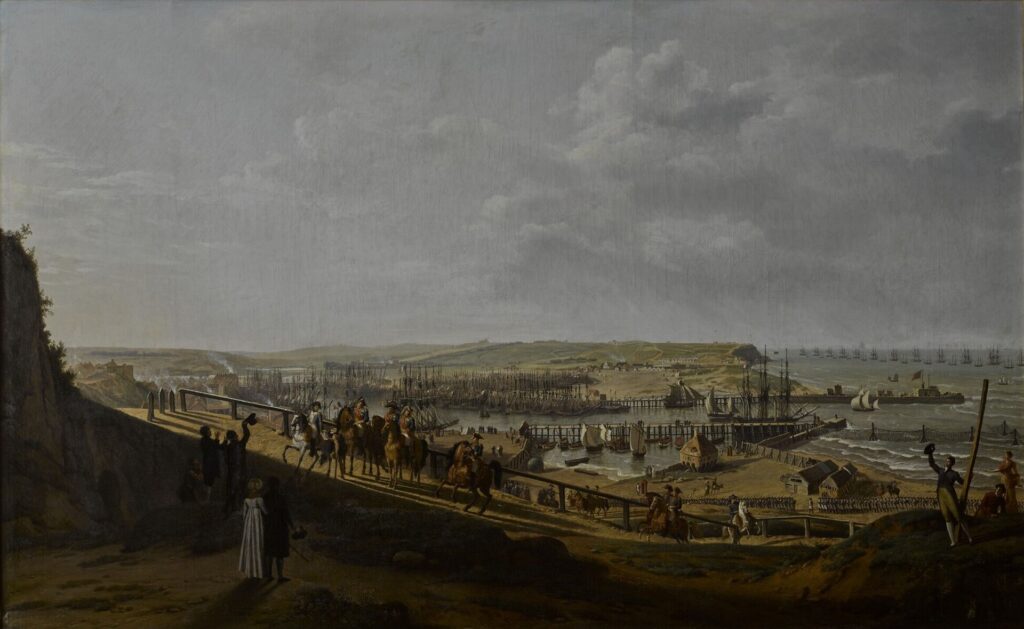
Between 1803 and 1805, the Boulogne camp was at the heart of Napoleon Bonaparte's plan to invade England. This vast military operation mobilised a large part of the army and the imperial fleet on the Channel coast.
Although the planned invasion was never completed, the Boulogne camp played an essential role in the formation of the Grande Armée. It is therefore a key episode in understanding the military organisation of the First Empire and the preparations for Napoleon's campaigns.
Long overshadowed by the great imperial victories, notably Austerlitz, the Boulogne camp is now emerging as a central object of study, at the crossroads of military history, local memory, heritage and archaeology.
From local memory to scientific research
In his article, Frédéric Lemaire points out that the history of the Boulogne camp has long been shaped by local accounts, learned societies and commemorative initiatives.
Over time, this regional memory has been enriched by new approaches. University research, archival studies and archaeological discoveries have enabled us to take a fresh look at the camp.
Today, this evolution allows us to better understand not only Napoleon's strategic decisions, but also the daily life of the soldiers, the organisation of the barracks, the material traces of the camp and its lasting place in the landscape.
Régis Jonckheere and André Lesage's book acclaimed
In this study, Frédéric Lemaire also highlights the importance of heritage enhancement work carried out by local players.
He cites in particular the work by Régis Jonckheere and André Lesage, The Boulogne camp: cradle of the Grande Armée, published in 2017 by Airvey. The author presents this book as a clear summary, abundantly illustrated, faithful to the local scholarly tradition and attentive to the heritage enhancement of the Boulogne camp.
This accolade is an important recognition of the work carried out to make the history of this emblematic site accessible to as many people as possible.
A shared heritage accessible to the public
Régis Jonckheere and André Lesage's book helps to bring the Boulogne camp to the attention of a wide audience. With its clear, illustrated approach, it helps to pass on a historical heritage that is essential to the Opal Coast and to European Napoleonic history.
This approach is fully in line with the objectives of Destination Napoleon: to bring the Napoleonic heritage to life through the regions, sites, museums, associations and local authorities working to promote it.
The Boulogne camp is not just the memory of an unfinished military project. It is also a place of remembrance, research and transmission, providing a better understanding of the birth of the Grande Armée and the European history of the First Empire.
Recognition for local players
This publication in Napoleonica. The Review recalls the essential role played by local players in preserving and promoting Napoleonic history.
Associations, historians, researchers, local authorities and enthusiasts all contribute in their own way to bringing this heritage to life. Their work helps to pass on a history that is local, national and European.
Associations, historians, researchers, local authorities and enthusiasts all contribute in their own way to bringing this heritage to life. Their work helps to pass on a history that is local, national and European.
The Boulogne camp highlights the wealth of Napoleonic heritage in the Hauts-de-France and Côte d'Opale regions.
A site at the heart of European history
Frédéric Lemaire's study confirms that the Boulogne camp occupies an important place in Napoleonic history. It is no longer just an episode linked to an abandoned invasion project, but a veritable military, human and heritage laboratory.
Its history provides a better understanding of the construction of the Grande Armée and Napoleon's European ambitions, as well as the way in which the territories preserve and pass on this memory today.
For Destination Napoleon, this publication is another opportunity to highlight the importance of local Napoleonic heritage in building a shared European memory.
Source :
Frédéric Lemaire, Writing and rereading the Boulogne camp: history, memory and archaeology, Napoleonica. The Review, No. 58, May 2026.
https://shs.cairn.info/revue-napoleonica-la-revue-2026-2-page-49?lang=fr