
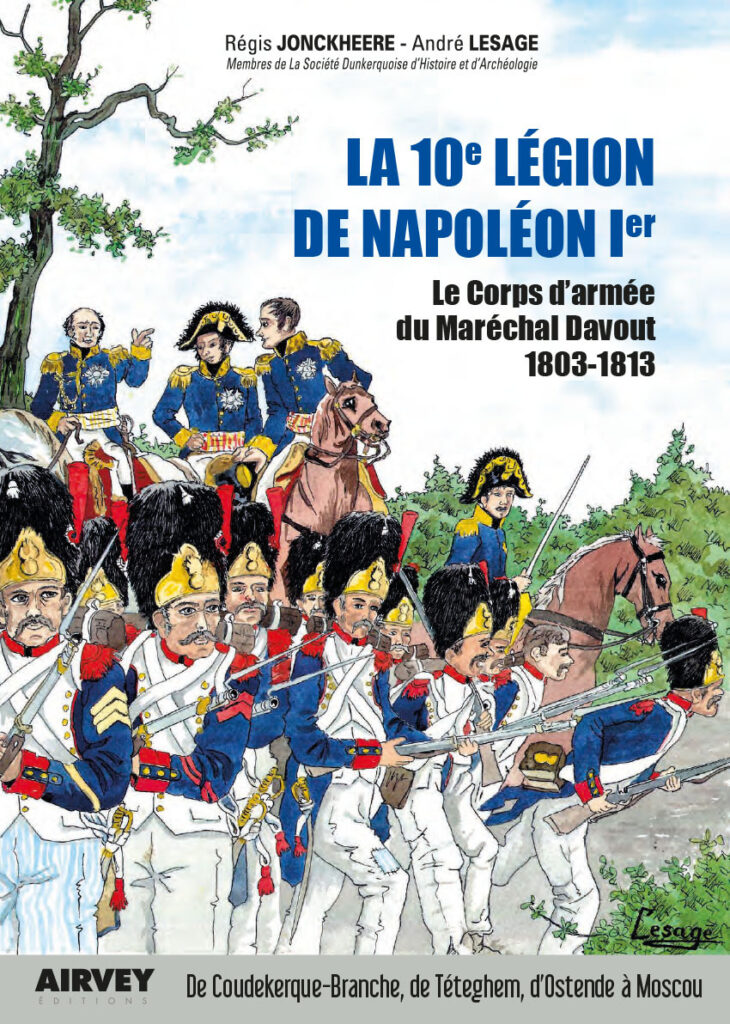
Description 2021 is the bicentenary year of the death of Napoleon I, Emperor of the French; one of the great strategists of history after Alexander the Great, Hannibal and Julius Caesar.
Around his sarcophagus in the crypt of the Invalides are inscribed his great victories: AUSTERLILZ 1805, JENA 1806, D'EYLAU 1807, WAGRAM 1809 and BORODINO 1812 but without DAVOUT's army corps the epic would not have been so brilliant!
The story begins in the summer of 1803. The First Consul Bonaparte decided to set up garrisons along the French and Belgian coasts. His strategy was to cross the Channel from the ports of Boulogne, Ambleteuse and Etaples in order to invade England. The coasts of the Hauts de France are home to nearly 100,000 men. Bonaparte entrusts the camp of Bruges to a young general of 33 years who already has a prestigious military career, Nicolas Davout.
That summer of 1803, a four-horse sedan headed for the Flemish coast, with the general-in-chief of the Bruges camp on board. His mission was to set up three military camps from Gravelines to the Dutch border.
The undertaking took on gigantic proportions. Davout forms three military camps, two on Ostend, one on the territories of Coudekerque-Branche and Téteghem, which will house the 30,000 men. For 22 months, these troops were trained in combat and discipline with the aim of setting foot on the British Isles! But history would decide otherwise!
Faced with the threat coming from the East, the Emperor leaves with his troops the Opal Coast for Bavaria to face the Austro-Russian army. On December 2, 1805, Napoleon won a resounding victory at Austerlitz, the architects of this success: the soldiers of DAVOUT. On the morning of October 14, 1806, Napoleon starts a battle in Jena with troops superior in number while DAVOUT and his 3rd corps start a fight in Auerstaedt facing an army stronger in number of soldiers than his own but the success is still there! In one day, the Prussian army is destroyed.
On 26 October 1806, in front of the Emperor, Marshal DAVOUT said "the 3rd Corps would always be worthy of the confidence of its sovereign and that it would be for him, in all circumstances, what the 10th Legion had been for Caesar. ". This quotation is true because until 1813, DAVOUT's divisions were the architects of the victories at Eylau, Regensburg, Eckmühl, Wagram, Smolensk and Borodino.
This year 2021 will also be marked by the return of the ashes of General Charles Etienne GUDIN, Marshal DAVOUT's lieutenant from 1803 to 1812, with a ceremony at the Hôtel des Invalides as part of the bicentenary of the Death of Napoleon 1st.
Author Régis Jonkheere, André Lesage
Publisher : Editions Airey
Date of publication 23 June 2021
Format 30.1 x 21.2 cm
Pages : 160
More information : https://www.airvey-editions.com/