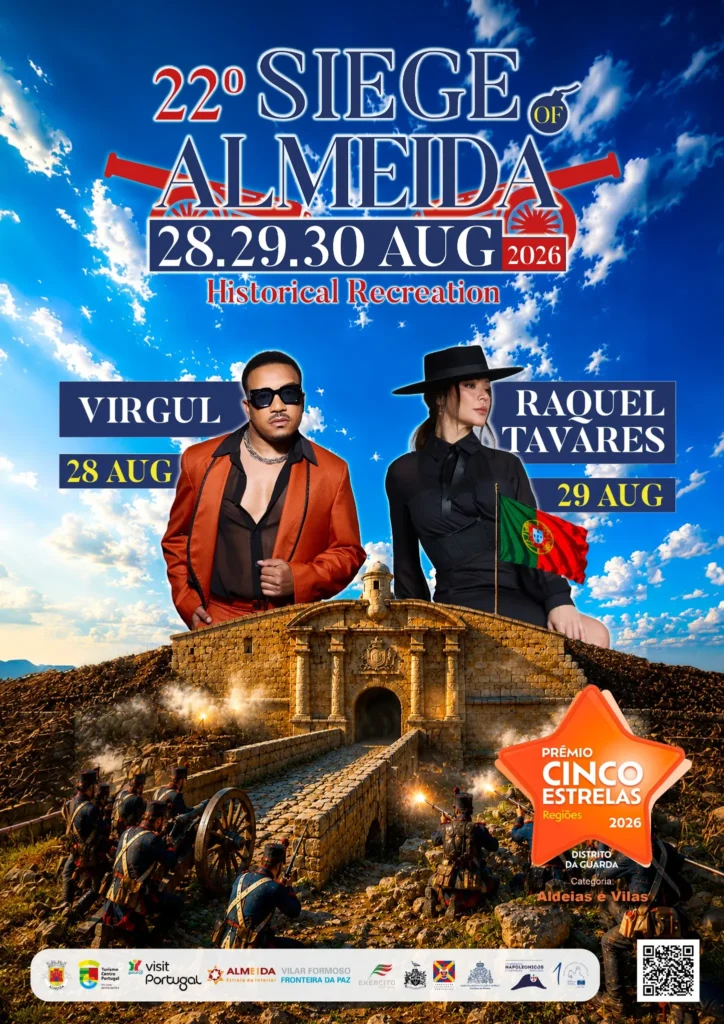
From 28 to 30 August 2026, Almeida will host the 22nd edition of its Historical Re-enactment of the Siege. Over the course of three days, the Portuguese fortified town will transform its heritage into a space where history, creativity, knowledge-sharing and community involvement come together.
The historical re-enactment of the 1810 siege of Almeida is the largest event dedicated to the Peninsular Wars held in Portugal and one of the most significant on the Iberian Peninsula. The event is organised directly by the Almeida Municipal Historical Re-enactment Group, the oldest Portuguese group dedicated to re-enacting this historical period. The event brings together around 450 to 500 historical re-enactors of various nationalities.
Far from being limited to a re-enactment of a battle, the event invites visitors to discover early 19th-century society in all its diversity. Military life, social customs, traditional dress, dances, trades and collective memory will take centre stage within the fortress, in the very places that were shaken by the events of 1810. The period military camp is open to the public and offers educational workshops focusing on both military and civilian life.
A new edition at the heart of the fortress
The historical re-enactment of the siege of Almeida will take place from 5.30 pm on Friday 28 August to 8.00 pm on Sunday 30 August. The local council has announced that admission to the event is free for the general public.
Throughout the weekend, the historic centre will be transformed into a stronghold from the early 19th century. Re-enactors, local residents, organisations, cultural institutions and visitors will all play their part in bringing this history to life.
This collective involvement is one of the event’s distinctive features. In Almeida, heritage is not )found solely in monuments or collections: it is also passed on through gestures, traditional dress, stories and the use of historic spaces.
The Siege of 1810: Key Dates
During the third French invasion of Portugal, Almeida served as a strategic stronghold on the route leading into the interior of the country. In August 1810, the stronghold, defended by an Anglo-Portuguese garrison, was besieged by the French army under the command of Marshal Masséna. On 26 August, a shell struck the fortress’s main powder magazine, located in the old castle. The explosion was devastating, causing numerous casualties and making it virtually impossible to continue the defence, due to a lack of gunpowder needed to manufacture ammunition.
The square fell two days later.
More than two centuries after the events took place, this re-enactment helps to place this episode within a broader historical context: that of populations facing war, border regions, and the profound changes experienced by the Iberian Peninsula during the Napoleonic era.
The night-time battle, the highlight of the weekend
On Saturday 29 August at 11.15 pm, the night-time battle will re-enact one of the most dramatic moments of the siege in the moat of the powder magazine ravelin.
Troop movements, gunfire and a re-enactment of the fortifications will give the public a better understanding of the intensity of the fighting and the consequences of the explosion that precipitated the fall of the stronghold.
A grandstand with 400 seats will be set up for this performance. Admission is restricted to those aged 10 and over, and tickets are available from the Almeida Historical and Military Museum. The admission fee for the grandstand is €2.
The power of this depiction lies, in particular, in its setting. The moats, ramparts and defensive structures are not merely a backdrop: they bear direct witness to the events being recounted.
Discovering the 19th century beyond the battlefield
The 2026 edition will also focus on social and cultural life in the 19th century. The organisation of a historical ball for children and young people illustrates this desire to explore the Napoleonic era in ways other than solely through military history.
Dances from the Napoleonic era do indeed offer an insight into the rules of conduct, social relations and cultural developments within a society undergoing profound change. The ball thus becomes a means of cultural engagement, combining learning, artistic practice and the exploration of heritage.
The municipality of Almeida invited the young participants to learn the dances of the period and to take part in this collective experience. This approach demonstrates how re-enactment can involve the younger generations in the very preparation of the event, rather than confining them to the role of mere spectators.
An event supported by the whole region
The historical re-enactment of the siege of Almeida involves far more than just historical re-enactment groups. It relies on the participation of local residents, organisations, municipal departments, heritage bodies and local businesses.
This collective effort has transformed the bastioned fortress of Almeida. Visitors can gain an insight not only into the military aspects of the siege, but also into the daily life of a population living in a wartime stronghold: supplies, healthcare, crafts, food, clothing, festivals and social interactions.
The event thus helps to strengthen the bond between the local population and its heritage. It also contributes to the appeal of a border region whose identity remains closely linked to its fortifications and its European history.
An initiative recognised by Destination Napoleon
In June 2026, the historical re-enactment of the Siege of Almeida was named the winner of the Destination Napoléon International Award. This award recognises the work carried out by the local council to promote the history of 1810, bring the fortress to life and make this heritage accessible to a wide range of visitors.
This recognition also highlights Almeida’s ability to place a military episode within a contemporary cultural context. The re-enactment does not glorify war: it helps us to understand its mechanisms, consequences and how it is remembered.
The symbolic descendants of peoples who were once at odds are now coming together at the same event. French, Portuguese, British, Spanish and participants of other nationalities are now gathering on the ramparts of Almeida in a spirit of dialogue and cooperation.
Almeida, a key stop on the Destination Napoleon tour
As a member of the European Federation of Napoleonic Cities, Almeida plays an important role in the ‘Destination Napoleon’ cultural route.
Through its exceptional military heritage, its museum, its educational work and its major annual re-enactment, the town helps to raise awareness of the history of the French invasions of Portugal and their impact on the people of the Iberian Peninsula.
This European involvement will reach another high point in 2027, when the city hosts the General Assembly of the European Federation of Napoleonic Cities.
As a border region, Almeida aims to establish itself as a key hub on a route dedicated to showcasing and promoting the battlefields, historic sites and activities linked to the Peninsular War, within the field of historical and military tourism.
The 22nd historical re-enactment of the siege will thus mark a new stage in the work Almeida has been carrying out to pass on this heritage: transforming a former battlefield into a vibrant place of learning, encounter and peace.
Practical information
Event: 22nd Historical Re-enactment of the Siege of Almeida
Dates from Friday 28 to Sunday 30 August 2026
General opening hours: from Friday at 5.30 pm to Sunday at 8 pm
Location: Historic centre and fortress of Almeida, Portugal
General access: free
Night battle: Saturday 29 August at 11 pm
Location of the battle: the moat of the powder magazine ravelin
Opinion piece: 400 seats, suitable for ages 10 and over
Organiser: Almeida municipality
Information: Almeida Tourist Office, Portas de São Francisco, Almeida
Contact: +351 271 570 020 – turismo.almeida@cm-almeida.pt
Information on watching the night-time battle from the grandstand: Almeida History and Military Museum, Rua da Muralha, Almeida. Admission: €2
Contact: +351 271 571 229 – museu.militar@cm-almeida.pt.